+971 52 306 0942
 +971 52 306 0942
 info@companysetup.ae

Blog
UAE Business Entity Types – Which Structure Should You Choose?
 By admin
Updated November 20, 2026
14 min read
In this article ⌄
- What Are the Different UAE Business Entity Types?
- Limited Liability Company (LLC)
- Sole Establishment or Sole Proprietorship
- Civil Company
- General Partnership
- Limited Partnership
- Public Joint Stock Company (PJSC)
- Private Joint Stock Company (PrJSC)
- Free Zone Establishment (FZE)
- Free Zone Company (FZCO or FZ LLC)
- Branch of a Local or Foreign Company
- Mainland vs Free Zone: Which Business Jurisdiction Should You Choose?
- a). Mainland Company
- b).Free Zone Company
- How to Choose the Right Business Entity in the UAE
- Business activity
- Number of shareholders
- Liability
- Business location
- Future expansion
- Registration and operating costs
- Documents Required to Register a Business Entity in the UAE
- Common Mistakes to Avoid When Selecting a UAE Business Structure
- Frequently Asked Questions About UAE Business Entity Types
- What are the main types of business entities in the UAE?
- Which business structure is best for foreign investors in the UAE?
- Can a foreigner own 100% of a company in the UAE?
- What is the difference between an LLC and an FZE?
- Is a sole establishment the same as an LLC?
- Get Professional Help With UAE Company Formation
- Planning to start a company in the UAE?
- About the Author:
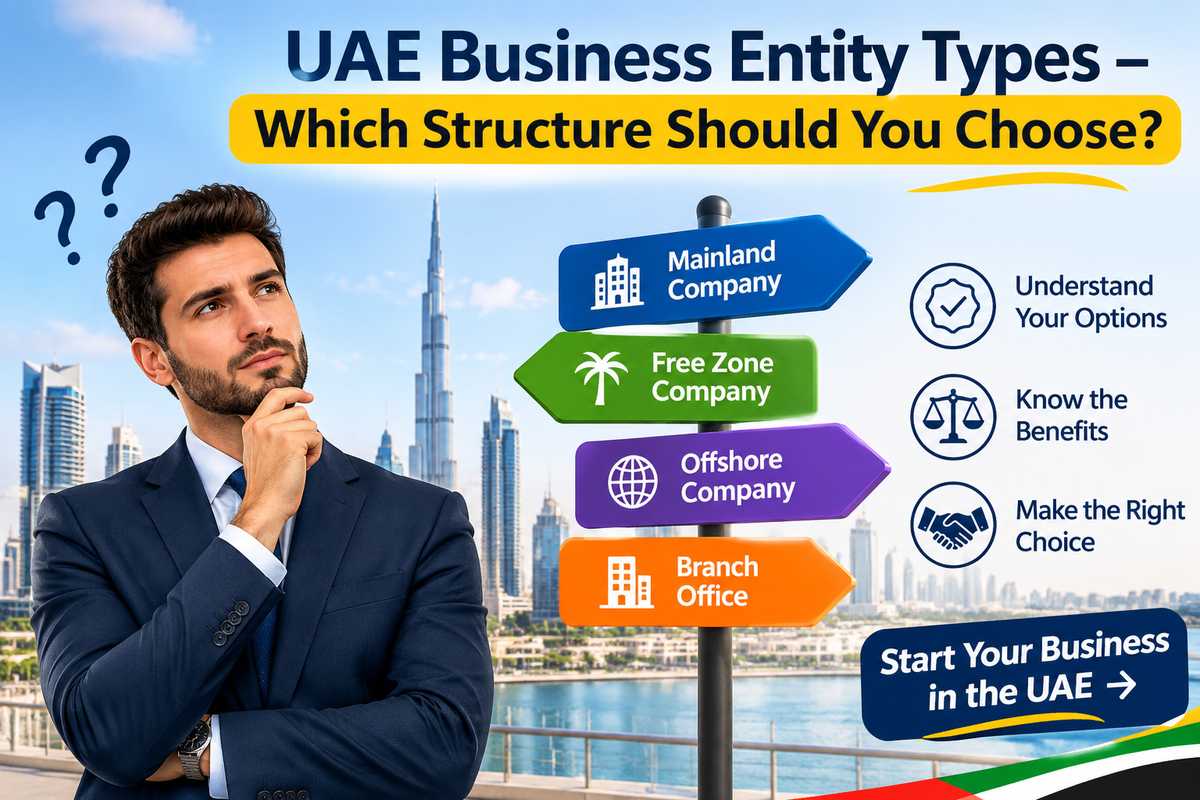
UAE Business Entity Types – Which Structure Should You Choose?
The selection of the appropriate UAE Business Entity Types is a crucial decision in establishing a business in UAE. The investors may opt for one of the legal structures like Limited Liability Companies (LLCs), sole establishments, civil companies, partnerships, joint stock companies or free zone entities. A UAE or foreign business may open a branch of its operations.
Ownership rights, liability and registration protocols are different for each structure. The choice will depend on your business activity, number of shareholders and your long term plans and who your target customers are.
There are two main business jurisdictions in the UAE: mainland and free zones. These are all registration jurisdictions, not legal entity types. For instance, a mainland LLC and a free zone company is issued by different licensing authorities and have different regulatory requirements.
Learn about Types of Business Entities in UAE, their salient features and selecting the right business entity structure.
What Are the Different UAE Business Entity Types?
There are a number of legal structures in which companies can be established in the UAE. The options available will be dependent on the emirate, licensing authorities, business activity and applicable regulations.
The main UAE Company Structures include:
- Limited Liability Company (LLC)
- Sole Establishment or Sole Proprietorship
- Civil Company
- General Partnership
- Limited Partnership
- Public Joint Stock Company (PJSC)
- Private Joint Stock Company (PrJSC)
- Free Zone Establishment (FZE)
- Free Zone Company (FZCO or FZ LLC)
- Branch of a Local or Foreign Company
Different Legal Forms of Business in UAE have different structures as far as ownership and management responsibilities and financial liability are concerned. Let’s explore them individually.
A Limited Liability Company (LLC) is a very popular business structure used by businesses in the UAE Mainland. It may have one or more members of the shareholders. Typically they are liable for the sum of their capital contributions.
Many trading, professional and service businesses can use an LLC. It can also be a sensible alternative for business owners who have business ventures in the United Arab Emirates (UAE) and want to work with their clients in the UAE.
Key features of an LLC:
- May have one or more shareholders, as per applicable rules.
- Shareholders’ liability is normally capped at their investment.
- Is able to conduct activities in accordance with its trade licence.
- Needs documents of incorporation such as Memorandum of Association (MOA) (if applicable).
- Offers 100% foreign ownership of numerous business activities.
Who should choose an LLC?
An LLC may be appropriate for entrepreneurs who desire a distinct legal entity that has a structured ownership structure. It can also be considered when you are employing staff, dealing with business partners or on the brink of expanding your business.
Foreign ownership is subject to the type of business and regulatory environment. There may be further requirements for certain strategic and regulated activities.
One establishment is a business that is owned and controlled by one person. The owner is the one that makes decisions for the business and runs the daily operations of the business.
Independent professionals, consultants and entrepreneurs considering running a business on their own will typically think of this structure.
Key features of a sole establishment:
- A person’s property.
- The owner is involved in the running of business.
- The owner is usually personally liable for the debts of the establishment.
- Requirements for licensing and local service agents will vary by activity and jurisdiction.
Who should choose a sole establishment?
This could be appropriate for a single practitioner wishing to work on his own without incorporating shareholders.
However, personal liability is an important consideration. Ensure that your activity requires professional qualifications, external approvals or a specific licensing arrangement before you register.
Two or more partners are usually required when providing qualified professional services, and a civil company is used for these circumstances. It may be appropriate in some consultancies and other practices.
Partners work under a legally agreed structure which defines the rights and responsibilities of the partners.
The features of a civil company are:
- Typically requires the involvement of two or more partners.
- Went to use for qualified professional activities.
- Needs the necessary partnership and registration paperwork.
- Conditions of ownership and liability will vary according to the laws in force and the type of licensed activity.
Who should choose a civil company?
It may be appropriate for those wishing to run a joint practice with a fellow professional. Consultancy and professional services companies are eligible if they do.
Up to the partners’ discretion, they need to verify if the licensing authority has any requirements prior to applying. Some activities must be accompanied by professional qualifications and extra approvals.
A general partnership is a form of partnership between two or more people. The business is co-owned and co-managed by the partners.
Each general partner could be personally liable for the partnership’s debts under the applicable UAE law.
The key features of a general partnership:
- Needs 2+ partners.
- Partners are involved in partnership business ownership.
- All partners are personally liable for the business obligations.
- Requires an appropriate partnership agreement and registration.
Who should choose a general partnership?
It would be suitable for partners who would like to run a business together and feel comfortable sharing the financial and management tasks.
But, personal liability may be more than the company’s assets. Before this option is implemented, the partners must be aware of the legal and financial liability that come with this option.
-
Limited Partnership
A limited partnership has two types of partners: general partners and limited partners.
General partners are usually involved in the day-to-day operations and typically are personally liable for the debts of the partnership. Limited partners are typically only liable for the capital that is invested in the company, subject to the relevant legal provisions.
The main characteristics of a limited partnership:
- Has one or more general partners.
- Has one or more limited partners.
- The business is run by the general partners.
- Limited partners invest money as per the terms agreed.
Who should choose a limited partnership?
A business with a limited partnership might be appropriate if some partners are active in the day-to-day affairs and others are primarily investors.
All partners shall determine in advance the amount of their capital investment and their management responsibilities and rights before the registration.
-
Public Joint Stock Company (PJSC)
Public Joint Stock Company (PJSC) is the corporate form that is specified for a company with a share capital issued in shares. It can sell shares to the public (as long as it is approved by the regulators).
This type of structure is typically appropriate for bigger businesses that require a significant investment and a formal shareholder structure.
Key features of a PJSC:
- Share capital is divided into shares.
- Shareholders generally have limited liability.
- Formation is subject to specific legal and regulatory requirements.
- Shares can be offered to the public when authorised.
- Must follow applicable corporate governance and disclosure rules.
Who should choose a PJSC?
A PJSC may suit a large business planning to raise funds from public investors. It can provide a formal structure for wider shareholding.
However, its incorporation and compliance requirements are more complex than those of a standard LLC.
-
Private Joint Stock Company (PrJSC)
A Private Joint Stock Company (PrJSC) is a company whose capital is divided into shares. Unlike a public joint stock company, it does not offer its shares to the public through a public subscription.
It can be suitable for larger privately held businesses that need a structured corporate ownership arrangement.
Key features of a PrJSC:
- Capital is divided into shares.
- Shares are not offered to the public through a public subscription.
- Shareholders generally benefit from limited liability.
- Must comply with applicable company and regulatory requirements.
Who should choose a PrJSC?
Businesses with several investors or shareholders may consider this structure when they need a formal shareholding arrangement without raising capital through a public offering.
-
Free Zone Establishment (FZE)
A Free Zone Establishment (FZE) is a company structure offered by participating UAE free zones. It is generally established with one shareholder.
Depending on the free zone’s regulations, the shareholder may be an individual or a corporate entity.
Key features of an FZE:
- Generally formed with one shareholder.
- Can provide 100% foreign ownership.
- Registered under the relevant free zone authority.
- Requires an appropriate free zone business licence.
- Office, visa and activity conditions depend on the selected free zone.
Who should choose an FZE?
An FZE may suit an individual entrepreneur or an existing company that wants to establish a separate business in a UAE free zone.
The right option depends on the permitted activity, ownership requirements, workspace needs and intended market.
-
Free Zone Company (FZCO or FZ LLC)
A Free Zone Company is a legal entity registered with a UAE free zone authority. Its legal name may be FZCO, FZ LLC or another designation approved by that authority.
Unlike an FZE, this structure commonly accommodates multiple shareholders. The exact ownership arrangements vary between free zones.
Key features of an FZCO or FZ LLC:
- Can accommodate multiple shareholders, subject to free zone rules.
- Allows full foreign ownership in eligible structures.
- Operates under the selected free zone’s regulations.
- Can obtain licences for approved commercial, professional or industrial activities.
- May offer different office, workspace and visa packages.
Who should choose an FZCO or FZ LLC?
This structure can suit entrepreneurs and investors who want to establish a free zone business with multiple owners.
The choice of free zone should be based on your business activity, customer base, office requirements and licensing conditions.
-
Branch of a Local or Foreign Company
An established UAE or international company can expand its operations by registering a branch in the UAE. The branch must follow the applicable registration and licensing requirements.
A branch generally operates as an extension of its parent company. It is not usually treated as a separate subsidiary.
Key features of a branch office:
- Connected to an existing parent company.
- Can conduct activities permitted under its approved licence.
- Requires relevant parent company documents.
- May need additional approvals depending on the business activity.
- The parent company’s liability generally extends to the branch’s obligations.
Who should choose a branch office?
An established company planning to enter the UAE market or expand into another emirate may consider a branch.
It allows the parent company to maintain its corporate identity while establishing a local business presence.
Mainland vs Free Zone: Which Business Jurisdiction Should You Choose?
Selecting a legal structure is only one part of setting up a company. You must also decide whether to register on the mainland or in a free zone.
Both jurisdictions have different licensing authorities, operating conditions and regulatory requirements. Your choice should reflect where and how you plan to conduct business.
a). Mainland Company
A mainland company registers through the relevant emirate’s economic department or other authorised licensing authority.
It can suit businesses that want to serve customers across the UAE mainland and participate in local commercial activities, subject to their licence and applicable regulations.
Mainland company advantages:
- Access to eligible business opportunities across the UAE.
- Suitable for many trading and service activities.
- Option to lease commercial premises according to licensing requirements.
- Can pursue government and private-sector opportunities, subject to relevant approvals.
b).Free Zone Company
A free zone company registers with a specific free zone authority. Each free zone has its own approved activities, facilities, regulations and company registration packages.
Free zone company advantages:
- 100% foreign ownership for eligible structures.
- Business activities designed for specific sectors.
- Different office and workspace options.
- Registration and administration through the relevant free zone authority.
A free zone company must follow the applicable rules when conducting business on the UAE mainland. Permissions or other arrangements may be required, depending on the activity and current regulations.
How to Choose the Right Business Entity in the UAE
The right option among the different Business Legal Structures UAE offers depends on your business model and future plans.
Consider these six factors before applying for a trade licence.
-
Business activity
Identify the exact activity you want to conduct. Your chosen activity can determine which legal structures, licences and approvals are available.
-
Number of shareholders
Decide whether you want to own the company individually, establish it with partners or include a corporate shareholder. The number and type of shareholders can affect your available options.
-
Liability
Consider how financial responsibility will be shared. Some structures generally limit shareholder liability, while sole establishments and certain partnerships can involve personal liability.
-
Business location
Compare mainland and free zone registration. Consider your target customers, operating requirements, office needs and the markets you intend to serve.
-
Future expansion
Think about your long-term plans. If you expect to bring in investors, add shareholders or enter new markets, choose a structure that can support those changes.
-
Registration and operating costs
Compare more than the initial licence price. Include registration charges, office rent, visa expenses, approval fees and annual renewal costs.
Documents Required to Register a Business Entity in the UAE
The documents required depend on the legal structure, business activity, shareholder details and licensing authority.
Common documents may include:
- Passport copies of all shareholders.
- Emirates ID and UAE visa copies, where applicable.
- Proposed company trade name.
- Details of the intended business activity.
- Application forms and initial approval documents.
- Memorandum of Association (MOA), where required.
- Articles of Association (AOA), where applicable.
- Parent company documents for branch registration.
- Professional qualifications or external approvals for regulated activities.
- Office lease or facility documents, where required.
Additional documents or attestations may be requested when a corporate shareholder or foreign parent company is involved. Confirm the exact checklist with the relevant licensing authority before submitting your application.
Common Mistakes to Avoid When Selecting a UAE Business Structure
Choosing an unsuitable legal form can lead to additional costs, compliance issues and registration delays.
Avoid these common mistakes:
- Selecting a company structure before confirming the permitted business activity.
- Assuming all UAE free zones have identical ownership and licensing rules.
- Ignoring personal liability under a sole establishment or partnership.
- Choosing a jurisdiction without considering your target customers.
- Overlooking professional qualifications and external approvals.
- Comparing licence prices without including office, visa and renewal expenses.
Reviewing your business activity, ownership plans and operating requirements before registration can help prevent unnecessary changes later.
Frequently Asked Questions About UAE Business Entity Types
-
What are the main types of business entities in the UAE?
The main legal forms include Limited Liability Companies (LLCs), sole establishments, civil companies, general partnerships, limited partnerships, public joint stock companies and private joint stock companies. Free zones also offer structures such as FZE and FZCO.
-
Which business structure is best for foreign investors in the UAE?
An LLC or free zone company can suit many foreign investors. The right choice depends on the business activity, ownership requirements, target market and operating plans.
-
Can a foreigner own 100% of a company in the UAE?
Yes. Foreign investors can own 100% of many mainland and free zone businesses. However, certain strategic activities and regulated sectors may have additional ownership conditions or approval requirements.
-
What is the difference between an LLC and an FZE?
An LLC is a legal structure commonly used for mainland businesses. An FZE is a free zone entity generally established with one shareholder. They differ in their licensing authority, registration process and operating conditions.
-
Is a sole establishment the same as an LLC?
No. A sole establishment has one individual owner who generally carries personal liability for business obligations. An LLC is a separate legal entity where shareholder liability is generally limited to their capital contribution.
Get Professional Help With UAE Company Formation
Choosing from the available UAE Business Entity Types requires careful consideration of your activity, ownership, liability and operating jurisdiction. Your decision should also support your future business plans.
CompanySetup.ae helps entrepreneurs and investors establish businesses in Dubai and across the UAE. Our team can assist with selecting a suitable company structure, preparing registration documents and arranging the required business licence.
Planning to start a company in the UAE?
Contact CompanySetup.ae to discuss your business requirements and get a company setup quote.
About the Author:
Company Setup is a trusted business setup consultants in Dubai, UAE, helping entrepreneurs, investors and established businesses start and grow their companies with confidence. Since 2013, our experienced consultants have provided end-to-end support for mainland and free zone company formation, trade licence applications and renewals, investor and residence visas, PRO services, corporate bank account assistance and business compliance.