+971 52 306 0942
 +971 52 306 0942
 info@companysetup.ae

Blog
How to Start an EV Charging Station Business in UAE
 By admin
Updated November 13, 2026
18 min read
In this article ⌄
- Why Start an EV Charging Business in the UAE?
- Some potential business opportunities include:
- Which EV Charging Business Model Should You Choose?
- EV Charging Station Management and Operation
- EV Charger Installation and Maintenance
- EV Charging Equipment Trading
- EV Charging Software and Technology
- Which Licence Do You Need for an EV Charging Station Business in the UAE?
- DEWA Approval for EV Charging Stations in Dubai
- Free charging services:
- Paid charging services:
- Which EV Chargers Need DEWA CPO Approval?
- What Does an EV Charge Point Operator Licence Require?
- New UAE EV Charger Technical Regulation Effective in 2026
- Mainland or Free Zone: Where Should You Register?
- Mainland Company Formation
- Free Zone Company Formation
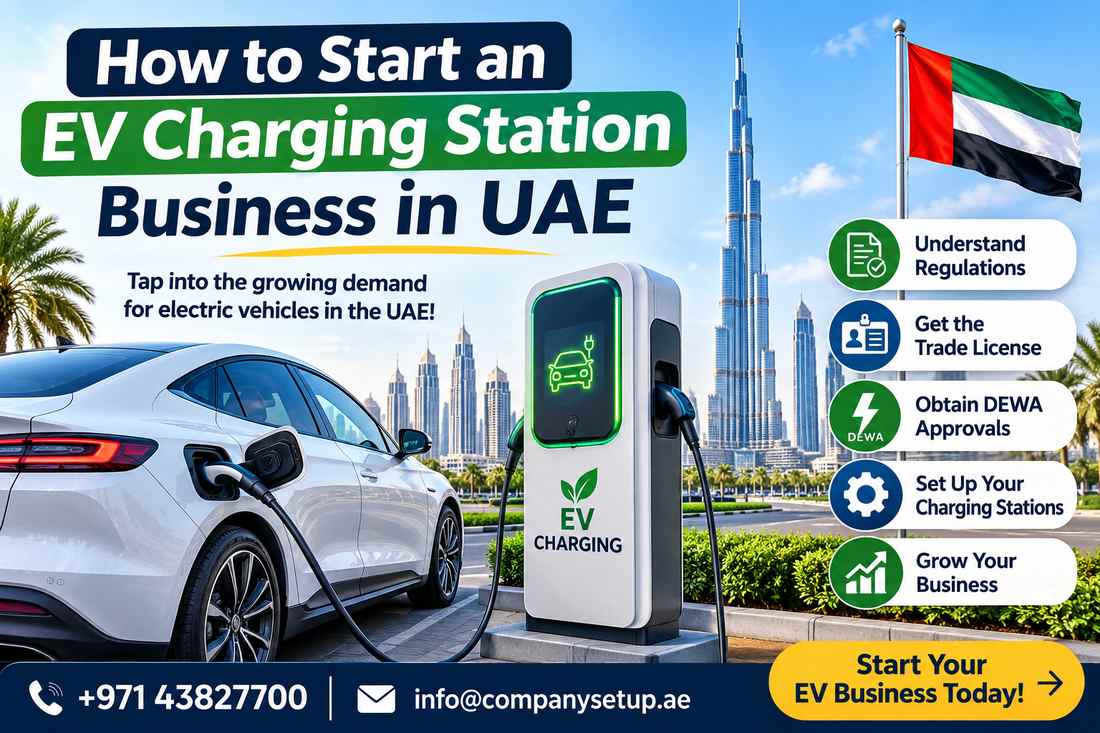
- How to Start an EV Charging Station Business in the UAE
- Step 1: Define Your Business Activities
- Step 2: Choose Your Business Jurisdiction
- Step 3: Reserve Your Company Name
- Step 4: Obtain Initial Approval
- Step 5: Secure Your Charging Location
- Step 6: Apply for DEWA and Other Relevant Approvals
- Step 7: Complete Company Registration and Obtain Your Trade Licence
- Step 8: Install and Commission Your Equipment
- Step 9: Complete Immigration and Tax Registration
- Get Your EV Charging Business License in the UAE
- How Much Does It Cost to Start an EV Charging Station Business in the UAE?
- What Are the DEWA CPO Licence Charges?
- What Is the Public Charging Tariff in Dubai?
- What Documents Are Required to Register an EV Charging Company?
- Tax and Compliance Requirements
- VAT registration:
- Corporate Tax:
- Licence renewal:
- Equipment verification:
- How CompanySetup.ae Can Help You Establish an EV Charging Business
- Planning to enter the UAE electric vehicle charging market?
- Frequently Asked Questions
- Do I need a DEWA licence to operate an EV charging station in Dubai?
- Can I start an EV charging business in a UAE free zone?
- How much does an EV charging station business cost in the UAE?
- Can I operate public EV charging stations without charging customers?
- Ready to Start Your EV Charging Station Business in UAE?
- About the Author:
Starting an EV Charging Station Business UAE is an opportunity for entrepreneurs looking to enter the growing electric mobility sector. Businesses can earn revenue by operating public charging stations, installing EV chargers, supplying charging equipment or offering maintenance services.
However, each business model has different licensing and approval requirements. For example, companies planning an EV Charging Business Dubai must understand the rules set by the Dubai Electricity and Water Authority (DEWA). A regular trade licence alone does not allow a company to operate a public EV charging network. Independent operators also need the relevant Charge Point Operator (CPO) licence.
The UAE has also introduced Cabinet Resolution No. 175 of 2025, which sets technical requirements for electric vehicle supply equipment. It came into effect on 27 May 2026.
This guide explains how to start an EV Charging Station Business UAE, including company formation, business activities, DEWA approvals, equipment standards, setup costs and ongoing compliance.
Start Your EV Charging Station Business in UAE Today
Why Start an EV Charging Business in the UAE?
The UAE is investing in electric mobility and developing its EV charging infrastructure. The National Electric Vehicles Policy, introduced in 2023, aims to expand the national charging network and encourage more people to use electric vehicles.
Dubai has also introduced its EV Green Charger initiative. DEWA reports that its network has more than 400 charging stations and can serve around 740 electric vehicles at the same time. Independent licensed operators also help expand the charging network.
This growth creates opportunities for businesses across the electric vehicle industry. An EV Charging Station Business UAE can focus on charging operations, equipment, installation or technology.
Some potential business opportunities include:
- Operating public EV charging stations at shopping malls, hotels and commercial properties.
- Installing charging equipment in residential and commercial buildings.
- Supplying AC and DC chargers to businesses and property owners.
- Providing charger inspections, maintenance and technical support.
- Developing charging management software and payment platforms.
Your business model will determine the licence, approvals and investment required. For example, an EV charger supplier follows a different approval process from a company that provides paid public charging services.
Which EV Charging Business Model Should You Choose?
Before registering your company, decide how you plan to earn revenue. Your selected business activities should accurately describe the services you intend to provide.
-
EV Charging Station Management and Operation
Under this model, your company owns, manages or operates charging stations and provides charging services to EV users.
You can explore locations such as hotels, shopping malls, office buildings, residential communities and commercial parking facilities.
If you plan to operate public charging equipment in Dubai, you must obtain the relevant DEWA CPO licence. This is an important requirement when planning an EV Charging Station Setup Dubai project.
-
EV Charger Installation and Maintenance
This model focuses on supplying and installing charging equipment for property owners, businesses and developers.
Your services may include:
- EV charger installation.
- Electrical connections and testing.
- Charger inspection and maintenance.
- Equipment repair and technical support.
An EV Charger Installation Business Dubai needs the appropriate electrical or technical contracting activity. You must also meet the relevant contractor and project approval requirements. DEWA and other competent authorities determine the approvals required for each installation.
-
EV Charging Equipment Trading
You can establish a company to import, distribute and sell electric vehicle chargers and related components.
Your product range may include wall-mounted chargers, commercial AC chargers, DC fast chargers, charging cables, connectors and accessories.
The company needs the correct commercial trading activities. Imported products must also meet the applicable UAE technical and product conformity requirements.
-
EV Charging Software and Technology
Another option is to develop software and technology for charging station operators and EV users.
Your company may offer charging management systems, mobile applications, payment integration, station monitoring and energy consumption reports.
Choose the appropriate software or technology activity based on the services you intend to provide. This model can also support businesses operating an Electric Vehicle Charging Business UAE.
Which Licence Do You Need for an EV Charging Station Business in the UAE?
The EV Charging Station Licence UAE requirements depend on your business model, location and operational responsibilities.
A company may need a commercial or technical activity on its trade licence, along with additional regulatory permissions.
For example, an operator planning to run public charging stations in Dubai needs the appropriate company registration and a separate DEWA CPO licence. This EV Charge Point Operator Licence authorises the relevant public charging operations, subject to its conditions.
The main licensing considerations are:
| Business activity | Main licensing consideration |
| Public EV charging operations | Relevant trade licence and DEWA CPO licence in Dubai |
| EV charger installation | Appropriate electrical or technical contracting activity and project approvals |
| EV charger trading | Commercial trading licence and product compliance |
| EV charging software | Relevant IT or software development activity |
| Charger maintenance | Appropriate maintenance or technical service activity |
Selecting an EV charging activity on a mainland or free zone application does not automatically give your company permission to operate public charging stations.
Before applying, confirm the activity code and external approval requirements with the relevant licensing authority. This step can help avoid delays during your EV Charging Station Business UAE registration.
DEWA Approval for EV Charging Stations in Dubai
DEWA regulates the development and operation of EV charging infrastructure in Dubai.
Under its regulatory framework, independent Charge Point Operators must obtain a CPO licence before operating public charging equipment. This requirement applies to companies that offer free charging as well as businesses that collect payments from customers.
DEWA provides two CPO licence categories:
Free charging services:
This category is for independent operators that provide public EV charging without collecting charging fees from end users.
Paid charging services:
This category is for operators that collect payments for public EV charging.
Both categories must follow the applicable licence conditions and technical regulations. Therefore, DEWA Approval for EV Chargers should be part of your business planning from the beginning.
Which EV Chargers Need DEWA CPO Approval?
The current framework makes a distinction between AC and DC charging equipment.
- AC chargers: DEWA provides a licensing route for independent operators.
- DC chargers up to 50 kW: Chargers at restricted-access locations, such as hotels, gated communities and employee parking areas, have a streamlined licensing route.
- Other DC chargers: These require specific DEWA approval.
DEWA currently directs applicants to contact its CPO licensing team for interim application procedures while its licensing portal arrangements develop.
You can contact DEWA at CPO.Licensing@dewa.gov.ae for application guidance.
For detailed requirements, visit the official DEWA EV Charging Regulatory Framework.
What Does an EV Charge Point Operator Licence Require?
An independent operator must follow the conditions of its DEWA licence and the applicable EV charging regulations.
Key requirements include:
- Obtaining the necessary authority approvals for each charging location.
- Meeting DEWA’s technical and safety requirements.
- Using an approved electricity connection.
- Paying the applicable CPO licence charges.
- Displaying clear charging prices and providing customer invoices.
- Keeping charging equipment compliant and operational.
Before purchasing chargers, plan your site agreements and electrical infrastructure. A suitable parking location may still need electrical upgrades and civil work before installation can begin.
New UAE EV Charger Technical Regulation Effective in 2026
Entrepreneurs planning to import, supply or operate charging equipment must consider Cabinet Resolution No. 175 of 2025.
The resolution establishes technical requirements for Electric Vehicle Supply Equipment (EVSE). It covers equipment used in public places and commercial locations to provide paid charging services.
The regulation came into effect on 27 May 2026.
It addresses important areas such as electrical safety conformity, measurement accuracy, equipment identification and verification.
Under the resolution:
- Suppliers must obtain the required electrical safety conformity certificate through the UAE Conformity Assessment System (ECAS) before placing equipment into public use.
- Suppliers and equipment owners must obtain the required metrological conformity certification.
- Charging equipment must display the required identification and technical information.
- Equipment must meet the applicable measurement accuracy standards.
- Periodic metrological verification must be completed annually.
The resolution excludes equipment intended for private residential use, provided it is not used to offer paid charging services to third parties.
For anyone starting an EV Charging Station Business UAE, equipment selection is an important part of regulatory planning. Do not compare chargers on price alone. Ask your supplier for the applicable conformity certificates, technical specifications and supporting documents before placing an order.
You can read Cabinet Resolution No. 175 of 2025 for the complete regulatory requirements.
Mainland or Free Zone: Where Should You Register?
Your company structure should match your planned operations, customer base and charging locations.
Mainland Company Formation
A mainland company may suit entrepreneurs who want to operate charging stations, undertake installation projects or provide technical services to customers across Dubai.
It provides a direct mainland business structure, subject to the approved activities and required external permissions.
Before applying, confirm the business activity and licensing requirements with Dubai’s Department of Economy and Tourism (DET).
For entrepreneurs planning an EV Charging Business Dubai, it is important to assess DEWA’s separate CPO licensing requirements before finalising the company structure.
Free Zone Company Formation
A free zone may suit businesses involved in eligible EV technology, software development, equipment trading and other permitted activities.
Some free zones list EV charging station management and operation as a business activity. However, having this activity on a free zone trade licence does not remove the separate DEWA CPO licensing requirement for public charging operations in Dubai.
Dubai’s EV charging regulations also apply within its free zones and special development zones.
| Consideration | Mainland | Free zone |
| Licensing authority | Relevant emirate economic department | Selected free zone authority |
| Ownership | 100% foreign ownership for eligible activities | 100% foreign ownership |
| Business operations | Direct mainland operations, subject to approvals | Subject to free zone licence and applicable mainland permissions |
| Suitable business models | Public charging operations, installation and technical services | Eligible technology, trading and other permitted activities |
| Additional approvals | Depends on activity and project | DEWA and other relevant approvals still apply |
If you plan to develop and operate a public charging network in Dubai, assess the mainland route carefully. A free zone may still work for eligible business models. However, check all operational permissions before choosing your jurisdiction.
How to Start an EV Charging Station Business in the UAE
Once you have selected your business model, you can begin the company formation and approval process.
Follow these steps to plan your EV Charging Station Setup Dubai project.
Step 1: Define Your Business Activities
Prepare a list of the services your company intends to provide.
For example, you may want to operate public charging stations, sell EV chargers and provide installation services.
Ask the licensing authority to confirm the correct activity codes. If you plan to combine different services, check whether your selected jurisdiction permits them under one licence.
Step 2: Choose Your Business Jurisdiction
Compare mainland and free zone company formation based on your customers, operating locations and regulatory requirements.
If you plan to operate public charging stations in Dubai, consider DEWA’s CPO licensing requirements before selecting your jurisdiction.
Step 3: Reserve Your Company Name
Choose a trade name that follows UAE naming regulations.
Submit your proposed name to the relevant licensing authority. Once approved, the authority will reserve it for your company registration.
Step 4: Obtain Initial Approval
Submit your company formation application with the selected business activities and shareholder details.
The licensing authority will review your application and identify any additional approvals required for your proposed activities.
Step 5: Secure Your Charging Location
Identify a suitable property for installing your charging equipment.
Potential locations include shopping centres, hotels, office buildings, petrol stations and commercial parking facilities.
Before finalising a location, check the following:
- Property owner permission.
- Availability of suitable parking spaces.
- Existing electrical capacity.
- Easy access for EV users.
- Civil work requirements.
- Electrical connection feasibility.
If you plan to use another company’s property, sign a written agreement. It should cover equipment ownership, electricity costs, customer access, maintenance responsibilities and revenue arrangements.
Step 6: Apply for DEWA and Other Relevant Approvals
If your company intends to operate public EV chargers in Dubai, apply for the appropriate DEWA CPO licence.
You must also obtain the required technical and site approvals before connecting and commissioning the equipment. This is a key part of the DEWA Approval for EV Chargers process.
Depending on the project, Dubai Municipality or RTA approvals may also apply. These can relate to civil works, road access, public parking and other site modifications.
Step 7: Complete Company Registration and Obtain Your Trade Licence
Submit the final documents and pay the applicable government charges.
Once the licensing authority approves your application, it will issue your trade licence.
Remember that a company trade licence does not replace the CPO licence required for public charging operations in Dubai.
Step 8: Install and Commission Your Equipment
Arrange installation through appropriately qualified technical professionals.
Complete the required electrical connection, testing, commissioning and conformity procedures before opening the charging station to customers.
If your company provides installation services to other businesses, ensure that it also meets the relevant requirements for an EV Charger Installation Business Dubai.
Step 9: Complete Immigration and Tax Registration
If you plan to employ technicians, engineers or station operators, arrange the relevant establishment registration and employee permits.
You should also assess your UAE VAT and Corporate Tax registration, accounting and filing obligations.
Get Your EV Charging Business License in the UAE
Ready to launch your EV charging business? Our experts can help you with company registration, trade licensing, regulatory approvals and the essential business setup procedures in the UAE.
How Much Does It Cost to Start an EV Charging Station Business in the UAE?
The investment required for an EV Charging Station Business UAE depends on the number of charging stations, equipment capacity, property arrangements and electrical infrastructure.
For example, installing a few AC chargers at an existing commercial property requires a different budget from developing a network of DC fast charging stations.
Consider these expenses when preparing your business plan:
| Cost category | What you need to budget for |
| Company formation | Trade name, registration and licence charges |
| CPO licensing | Applicable DEWA licence charges in Dubai |
| Charging equipment | AC chargers, DC chargers, cables and connectors |
| Electrical infrastructure | Power supply, distribution equipment and connection work |
| Civil work | Foundations, cable trenches, parking modifications and signage |
| Property | Lease, parking arrangements or revenue sharing |
| Software | Payment systems, charger monitoring and customer applications |
| Staff | Engineers, technicians and operational employees |
| Maintenance | Inspections, repairs and replacement components |
| Working capital | Electricity, rent, salaries and operating expenses |
What Are the DEWA CPO Licence Charges?
DEWA’s November 2025 regulatory framework publishes the following initial annual CPO licence charges for public charging equipment:
| Charger type | Initial annual licence charge |
| AC public charger | AED 500 per charging port |
| DC public charger | AED 100 per kW of output capacity, capped at AED 7,500 per port |
For a two-port AC charger, the annual licence charge is AED 1,000.
A two-port DC charger with a total output capacity of 150 kW carries an annual charge of AED 15,000, based on the stated per-kW rate and cap.
These charges apply to the CPO licence. They do not represent the total cost of establishing an EV charging station. DEWA may also revise the charges under its regulatory framework.
What Is the Public Charging Tariff in Dubai?
The regulation initially sets the following public charging fees:
- AC charging: AED 0.70 per kWh, plus VAT.
- DC charging: AED 1.20 per kWh, plus VAT.
The CPO’s charging fee forms part of the total public charging fee. The total also includes the applicable DEWA electricity tariff and fuel surcharge.
Therefore, these figures should not be treated as the operator’s net revenue.
Before investing in an EV Charging Business Dubai, prepare a financial plan that includes electricity costs, site rent, equipment depreciation, maintenance and charger utilisation. These factors will affect the business’s operating costs and profitability.
What Documents Are Required to Register an EV Charging Company?
The exact documents depend on your selected jurisdiction, company structure and business activities. The licensing authority will confirm the final checklist.
Common company formation documents include:
- Passport copies of shareholders and directors.
- UAE visa and Emirates ID copies, where applicable.
- Proposed company name.
- Selected business activities.
- Shareholder and manager details.
- Completed company registration application.
- Memorandum of Association, where applicable.
- Registered office or address documents, where required.
- External approval documents, if applicable.
For charging station operations, you may also need additional project documents.
These can include property owner consent, site plans, charger specifications, electrical load details, equipment conformity documents and technical drawings.
Preparing these documents early can make the EV Charging Station Setup Dubai process easier to manage.
Tax and Compliance Requirements
After establishing your company, you must follow the UAE’s applicable tax and regulatory requirements. These obligations also apply to businesses operating an Electric Vehicle Charging Business UAE.
VAT registration:
The Federal Tax Authority requires UAE resident businesses to register for VAT when taxable supplies and imports exceed AED 375,000 over the previous 12 months or are expected to exceed that amount within the next 30 days. Voluntary registration may be available when the relevant threshold of AED 187,500 is met.
Corporate Tax:
Your company must assess its Corporate Tax registration, accounting and filing obligations under UAE Corporate Tax legislation.
Licence renewal:
Renew your trade licence and applicable regulatory authorisations within the required periods.
Equipment verification:
Paid public and commercial EV charging equipment must meet the applicable federal conformity and metrological requirements. This includes annual verification where required.
Technical maintenance: Keep charging equipment, electrical connections and customer charging systems in proper working condition. Arrange regular inspections and repairs when necessary.
How CompanySetup.ae Can Help You Establish an EV Charging Business
Starting an EV charging company involves more than obtaining a trade licence. Company registration, equipment compliance and infrastructure approvals follow different procedures.
CompanySetup.ae can assist entrepreneurs with the company formation process, including:
- Selecting suitable EV charging business activities.
- Comparing mainland and free zone company formation.
- Reserving a company trade name.
- Preparing shareholder and registration documents.
- Applying for initial approval and trade licence issuance.
- Assisting with establishment and visa procedures.
- Advising on relevant external approval requirements.
For public charging operations in Dubai, your company must also meet DEWA’s separate CPO licensing and technical requirements. Include these approvals in your project plan before committing to equipment or property expenses.
Planning to enter the UAE electric vehicle charging market?
Contact CompanySetup.ae to discuss your proposed business model, licensing options and company formation requirements.
Frequently Asked Questions
-
Do I need a DEWA licence to operate an EV charging station in Dubai?
Yes. Independent operators of public EV charging equipment must obtain a DEWA CPO licence. This requirement applies to both free and paid public charging services.
A regular trade licence does not replace the required CPO authorisation.
-
Can I start an EV charging business in a UAE free zone?
Yes. You can establish an EV charging company in a UAE free zone if the selected authority permits your proposed business activities.
However, a free zone trade licence does not replace DEWA’s CPO licence for public charging operations in Dubai. You must also meet the relevant operational and technical requirements.
-
How much does an EV charging station business cost in the UAE?
There is no single fixed investment amount. The total cost depends on charger capacity, equipment, electrical infrastructure, site arrangements, company formation and regulatory charges.
Your budget should also include property costs, software, maintenance, staff and working capital.
-
Can I operate public EV charging stations without charging customers?
Free public charging is also covered by DEWA’s CPO licensing framework in Dubai.
Independent operators must obtain the relevant free charging licence and comply with the applicable technical and regulatory requirements.
Ready to Start Your EV Charging Station Business in UAE?
Turn the growing demand for electric vehicle charging into a business opportunity. Our business setup experts can guide you through company registration, trade licensing, activity approvals and the required regulatory procedures.
Get in touch today for professional EV charging business setup assistance in the UAE.
📞 +971523060942
About the Author:
Company Setup is a trusted business setup consultants in Dubai, UAE, helping entrepreneurs, investors and established businesses start and grow their companies with confidence. Since 2013, our experienced consultants have provided end-to-end support for mainland and free zone company formation, trade licence applications and renewals, investor and residence visas, PRO services, corporate bank account assistance and business compliance.